Digital Rupee vs UPI: What’s the Real Difference?
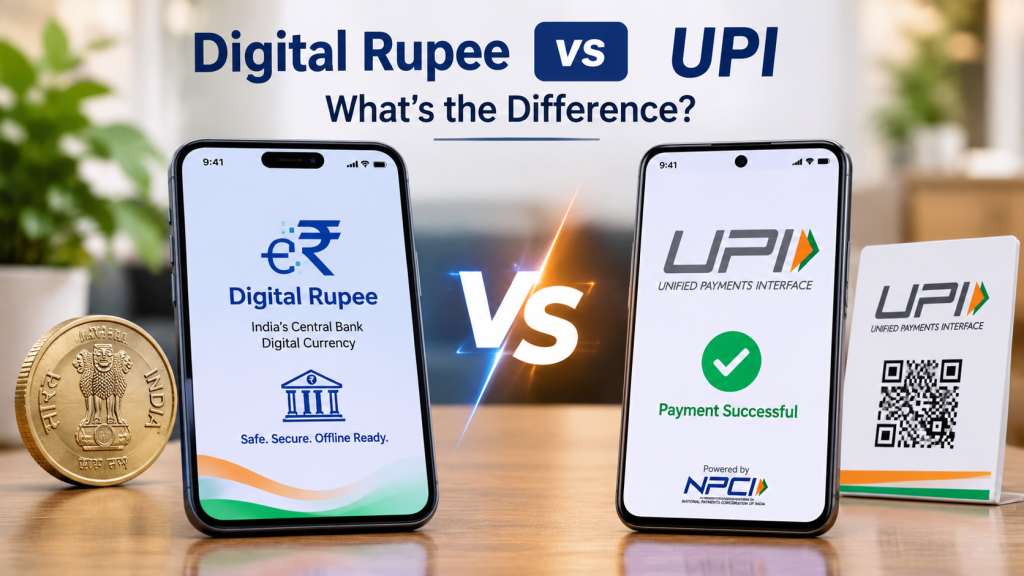
India has experienced a major transformation in digital payments. Today, millions of people use UPI to pay for groceries, transfer money, shop online, and settle everyday expenses. But another financial technology is gaining attention: the Digital Rupee (e₹).
Introduced by Reserve Bank of India (RBI), the digital rupee represents India’s digital form of physical currency. Although both digital Rupee and UPI allow people to make digital payments, they work differently.
So, what exactly separates them? Is Digital Rupee better than UPI? Let’s understand the differences.
- What Is Digital Rupee?
The Digital Rupee, also known as e₹, is India’s Central Bank Digital Currency (CBDC), issued by the Reserve Bank of India.
Unlike private cryptocurrencies such as Bitcoin, the Digital Rupee is official Indian Currency and is backed by the RBI. It has the same value as physical rupees. For example, ₹100 in Digital Rupee has the same value as a physical ₹100 note.
Users can store Digital Rupees in a dedicated digital wallet provided by participating banks and non-bank service providers.
The RBI launched its retail Digital Rupee pilot in December 2022 to explore how digital currency could be used for everyday payments.
- What Is UPI?
Unified Payments Interface (UPI) is a real-time payment system developed by the National Payments Corporation of India (NPCI).
It allows users to transfer money directly between bank accounts using mobile applications. Customers can make payments by scanning QR codes, entering UPI IDs, or selecting registered contacts.
UPI has transformed India’s payment ecosystem by making digital transactions quick and convenient.
From small shops to large businesses, UPI is now widely accepted across the country.
- Digital Rupee vs UPI: Key Differences
Although both technologies support digital transactions, their underlying functions are different.
| Feature | Digital Rupee | UPI |
| Meaning | Digital form of Indian currency | Digital Payment System |
| Issued or operated by | RBI | NPCI |
| What it represents | Digital money | Payment method |
| Storage | Digital Rupee wallet | Linked Bank account |
| Transaction | Wallet-to-wallet | Bank-to-bank |
| Interest | No interest on wallet balance | Depends on the linked bank account |
| Main purpose | Digital currency and payments | Fast money transfers |
The biggest difference is simple: Digital Rupee is money in digital form, whereas UPI is a method of transferring money between bank accounts.
- How Do Digital Rupee Transactions Work?
Digital Rupee works through a dedicated e₹ wallet.
First, users load Digital Rupees into their wallets from their linked bank accounts. They can then send or receive digital currency through supported transactions.
For example, imagine you have ₹1,000 in your Digital Rupee wallet. You purchase groceries worth ₹300 and pay the shopkeeper using the Digital Rupee wallet.
The ₹300 moves from your wallet to the merchant’s Digital Rupee wallet. The transaction is settled between the two wallets without passing through the users’ bank accounts.
This is one of the important differences between Digital Rupee and UPI.
- Can Digital Rupee and UPI Work Together?
Interestingly, these two technologies are not completely separate.
The RBI has enabled interoperability between Digital Rupee and UPI. This means users can scan compatible UPI QR codes at merchant locations using supported Digital Rupee applications.
This makes Digital Rupee more convenient because merchants do not necessarily need an entirely separate QR code infrastructure.
It also helps connect the growing Digital Rupee ecosystem with India’s existing digital payment network.
- Is Digital Rupee Safer Than UPI?
Both systems operate within regulated financial frameworks, but they have different security requirements.
Digital Rupee is issued by the RBI and represents sovereign currency. UPI transactions are processed through the banking system and supported by NPCI’s payment infrastructure.
However, neither system makes users completely immune to cyber fraud.
Fake payment links, phishing messages, fraudulent applications, and social engineering attacks can affect digital payment users.
To stay safe:
- Never share your OTP or UPI PIN
- Download financial applications from trusted sources.
- Avoid suspicious payment links and QR codes.
- Check recipient details before confirming transactions.
- Report suspicious transactions to your bank immediately.
Digital convenience must always be supported by responsible financial behaviour.
- What Is the Future of Digital Rupee in India?
The Digital Rupee is still being tested through RBI’s retail and wholesale pilot programmes. According to the RBI’s Oct are participating in providing CBDC wallets.
The technology also offers possibilities beyond ordinary payments. Programmable Digital Rupee could allow funds to be used for specific purposes, such as eligible government benefit programmes.
The RBI is also exploring offline payment capabilities, which could eventually help users transact in areas with limited internet connectivity.
These developments could create new opportunities for financial inclusion, government payments, and digital transactions.
However, wider adoption will depend on customer awareness, merchant acceptance, technology, and practical everyday benefits.
Conclusion: Digital Rupee or UPI- Which One Should You Choose?
Digital Rupee and UPI serve different purposes in India’s financial ecosystem.
UPI makes transferring money from one bank account to another simple and convenient. Digital Rupee introduces a new way to hold and transfer official Indian currency in digital form.
For everyday payments, UPI remains a familiar and widely accepted option. Digital Rupee offers additional possibilities that could shape the future of digital money.
At 360 Money, we believe understanding emerging financial technologies helps people make smarter financial decisions. As India’s digital economy continues to grow, staying informed about innovations like Digital Rupee and UPI is becoming increasingly important.
The future of money may not be about choosing between Digital Rupee and UPI but understanding how both technologies can work together to transform the way India pays and manages money.