Will Your Smartphone Become Your Future Bank?
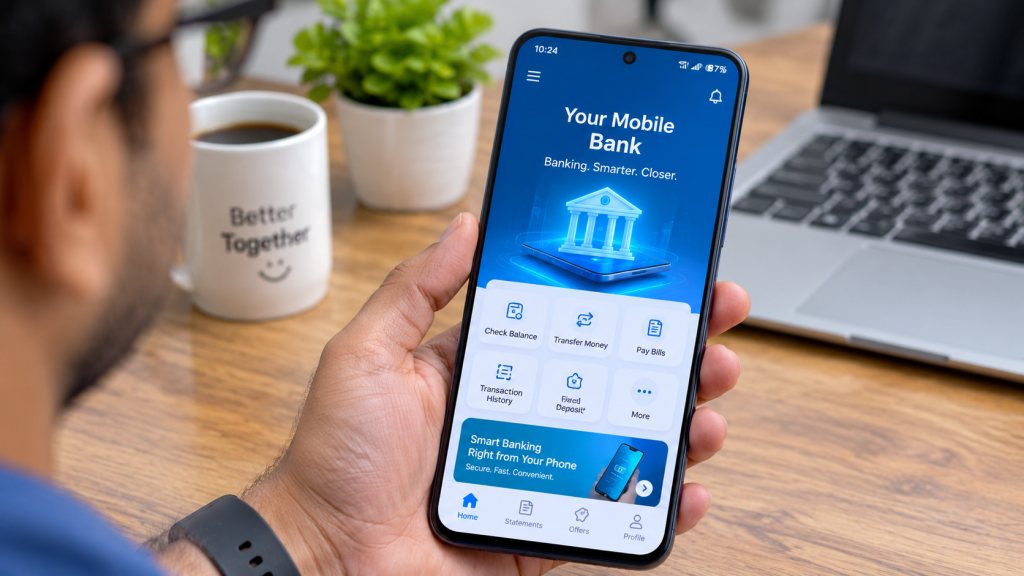
Imagine waking up in the morning, checking your bank balance, paying your electricity bill, transferring money to a friend, investing in mutual funds, and reviewing your monthly expenses all without visiting a bank or standing in a queue. Everything happens through one device: your smartphone.
This is no longer just an idea from the future. Mobile banking, digital payments, artificial intelligence (AI), and financial technology are already changing how people manage their money. As these technologies continue to develop, smartphones could become the primary way people access almost every banking service.
But will smartphones eventually replace traditional banks? Let’s explore how the future of banking is taking shape.
- Banking Is Moving From Branches to Smartphones
Traditional banking once required customers to visit physical branches for everyday activities such as transferring money, checking account balances, or applying for financial services. Today, most of these tasks can be completed through mobile banking applications.
Customers can check transactions, transfer funds, pay bills, manage deposits, apply for loans, and receive instant banking notifications using their smartphones.
This shift is making financial services faster and more convenient. People can manage their finances at any time without depending entirely on bank working hours.
- UPI Is Transforming Digital Payments in India
India’s Unified Payments Interface (UPI) has transformed everyday payments. From supermarkets to small roadside shops, people can make payments simply by scanning a QR code.
According to NPCI data, UPI processed approximately 25.47billion transactions worth ₹31.53 lakh crore in October 2026. This demonstrates how deeply digital payments have become part of everyday financial activities in India.
UPI enables instant bank-to-bank transfers making payments easier for individuals and businesses.
As digital payment technology develops, smartphones are likely to become even more important in India’s Financial ecosystem.
- Artificial Intelligence Could Make Banking Smarter
Artificial intelligence is expected to play an important role in the next generation of mobile banking.
Imagine asking your banking application, “How much did I spend this month?” or “How can I save ₹ 5,000 every month?”
An AI powered financial assistant could analyse spending patterns, identify unnecessary expenses, provide personalised financial insights, and help customers plan their budgets.
AI can also help banks identify unusual transactions and detect potentially fraudulent activities.
Future banking applications may become intelligent financial assistants rather than simply displaying account information.
- Your Smartphone Could Become an Investment Platform
Banking applications are gradually becoming gateways to several financial services.
In addition to managing savings accounts, customers can access mutual funds, fixed deposits, insurance services, digital gold, and other investment products through digital platforms.
For example, a young professional could check monthly expenses, start a systematic investment plan (SIP), review savings, and monitor financial goals using a smartphone.
This could make investment opportunities more accessible, particularly for beginners. However, customers should understand the risks, charges, and suitability of financial products before making financial decisions.
- Contactless Payments Could Change Shopping Habits
Near Field Communication (NFC) allows compatible devices to exchange payment information over short distances. Customers can use supported smartphones and smartwatches to make payments at compatible payment terminals.
In the future, connected devices, wearable technology, and even smart vehicles could become additional payment channels.
This could make everyday transactions faster by reducing the need to carry physical cards or cash.
- Is Smartphone Banking Safe?
Despite its convenience, digital banking comes with security risks. Cybercriminals use phishing messages, fake banking applications, fraudulent links, and identity theft to target customers.
Common threats include fake customer care calls, fraudulent QR codes, fake loan applications, and malware designed to steal personal information.
The Reserve Bank of India introduced its 2026 digital Payment Security Controls Directions for Payments Banks, covering areas such as authentication, mobile payment application security, fraud management, and customer protection.
Customers should download banking applications only from trusted sources, avoid suspicious links, never share OTPs or UPI PINs, and enable available security features.
If an unauthorised digital transaction occurs in India, customers should immediately contact their bank and report the incident through the national cybercrime helpline 1930.
Financial security must remain a priority as digital banking grows.
- Will Traditional Banks Disappear?
Even as digital banking expands, traditional bank branches will continue to serve an important purpose.
Some customers prefer personal assistance when handling complicated financial decisions, resolving disputes, or completing documentation. Senior citizens and people with limited digital literacy may also feel more comfortable visiting physical branches.
Therefore, the future of banking is more likely to combine digital convenience with traditional customer support rather than completely eliminate physical banks.
Conclusion: Your Next Bank Could be in Your Pocket
Smartphones are already transforming how people save, spend, transfer, and invest money. With the continued development of AI, UPI, and mobile financial services, managing money could become easier and more personalised than ever before.
However, technology alone cannot define the future of banking. Security, privacy, accessibility and customer trust will remain equally important. Traditional banks may not disappear, but the way people interact with them is changing rapidly.
At 360 Money, we believe understanding these financial changes is essential for making smarter money decisions. Stay informed, explore emerging financial technologies, and take control of your financial future.
Perhaps the biggest question is no longer whether your smartphone can become your future bank, but much of your financial life you will eventually manage through it.